
WiSED 2027 Winter School & Workshop
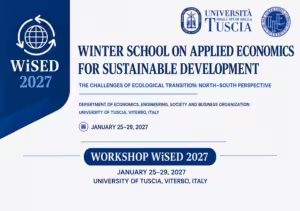
The 2nd Winter School & Workshop on Applied Economics for Sustainable Development (WiSED 2027) will take place at the University of Tuscia in Viterbo on 25–29 January 2027, on the theme “The Challenges of Ecological Transition: North-South Perspectives.”
The programme is specifically designed for graduate students, postdoctoral researchers and early-career scholars from Europe and Latin America working on development studies, ecological transition, blue economy and ecological macroeconomics. It also includes a workshop on 27 January, with selected papers invited to submit to a Special Issue in an international journal.
Deadline: 15 October 2026
– – –
The Winter School on Applied Economics for Sustainable Development (WiSED) 2027) marks the second edition of this international academic initiative. Together with the Summer School on Applied Economics for Latin America (EVEAAL), WiSED forms part of a broader academic network dedicated to building an international community of scholars interested in applied economics, economic development, and sustainable development from heterodox perspectives.
Both initiatives share a common vision: to create lasting academic networks by bringing together students, early-career researchers, and senior scholars in an environment that encourages learning, collaboration, and the exchange of ideas. Rather than being isolated training events, WiSED and EVEAAL aim to foster a vibrant international community that promotes long-term research collaborations, interdisciplinary dialogue, and the development of new generations of researchers committed to addressing the economic and social challenges facing Latin America and other developing regions.
WiSED 2027 is jointly organized by the Faculty of Economics, University of Tuscia (UNITUS) and the Institute of Economic Research of National Autonomous University of Mexico (UNAM).
WiSED was conceived as a space for dialogue among scholars, students, and researchers interested in understanding the challenges of economic development and sustainable development from a heterodox perspective. While the School welcomes intellectual diversity, its academic identity is grounded in traditions such as Latin American Structuralism, Post-Keynesian Economics, Institutional Economics, Ecological Economics, Feminist Economics, and other critical approaches that seek to understand development beyond conventional frameworks.
 Mario Cedrini